Directional Drilling (HDD)

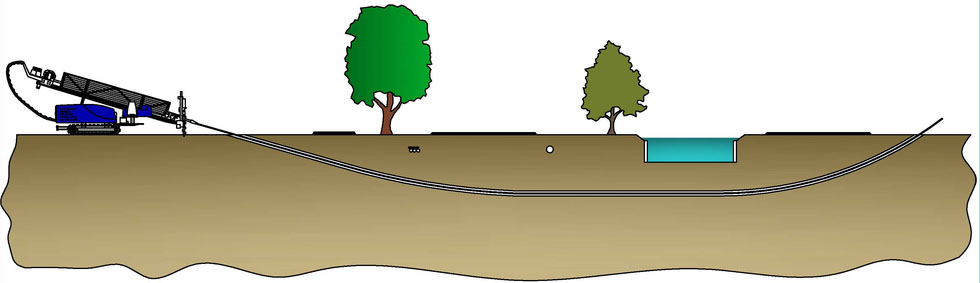
The HDD (Horizontal Directional Drilling) technique makes it easy to cross objects over longer distances without digging trenches. A small excavation at the start and end of the borehole is sufficient to enable the crossing.

Quick links:

What is directional drilling?

With HDD technology, pipes made of HDPE, steel, cast iron, GRP, and GRE can be installed, which serve as sheathing or medium-carrying pipes for drinking water, wastewater, process water, low-pressure gas, high-pressure gas, biogas, district heating, oil, fiber optic, medium-voltage, and high-voltage cables.

In the past, HDD drilling was primarily used for crossing rivers, canals, railways, and highways. Today, this technique is increasingly being used for crossing sensitive nature areas, existing cables and pipelines, rows of trees, and in industrial and urban areas.
About directional drilling

HDD drilling is carried out using a drill rig. The capacity of the drill rig determines the length and diameter that can be achieved. Holland Drilling has a modern and comprehensive range of machinery that enables it to work efficiently in accordance with the specified requirements and standards. The fleet includes eight HDD drill pipes with a capacity of 2.5 to 150 tonnes, which can achieve lengths of more than 1,000 metres and diameters of up to 900 mm.

What makes these machines unique is their exceptional compactness. Holland Drilling owns the most compact 45- and 150-ton drilling rigs on the market, allowing it to reach locations inaccessible to others.

We use state-of-the-art technology to lay out and measure the borehole, and to locate existing cables and pipes. Our on-site staff have all the information available online and record the borehole parameters digitally.